Mash-ups of Lawrence Welk Show footage with rock songs never caught on as an Internet meme, but I never get tired of them. This one is extremely well done:
Mash-ups of Lawrence Welk Show footage with rock songs never caught on as an Internet meme, but I never get tired of them. This one is extremely well done:
New reduced price on the electronic version, so click on over here. Please note that the eBook is still free from Amazon with purchase of the print version.
And I don’t care that the Packers didn’t go this year:
. . . but it never gets old:
Many thanks to Rod Lott, who reviews all manner of stuff at his blog Flick Attack. Rod was kind enough to ask me to contribute five movie recommendations in connection to ROBOT MONSTER, so please click on over to Rod’s site and read a list that I think at least avoids being too obvious. (And they really do have ROBOT MONSTER connections. Kinda-sorta. I promise.)
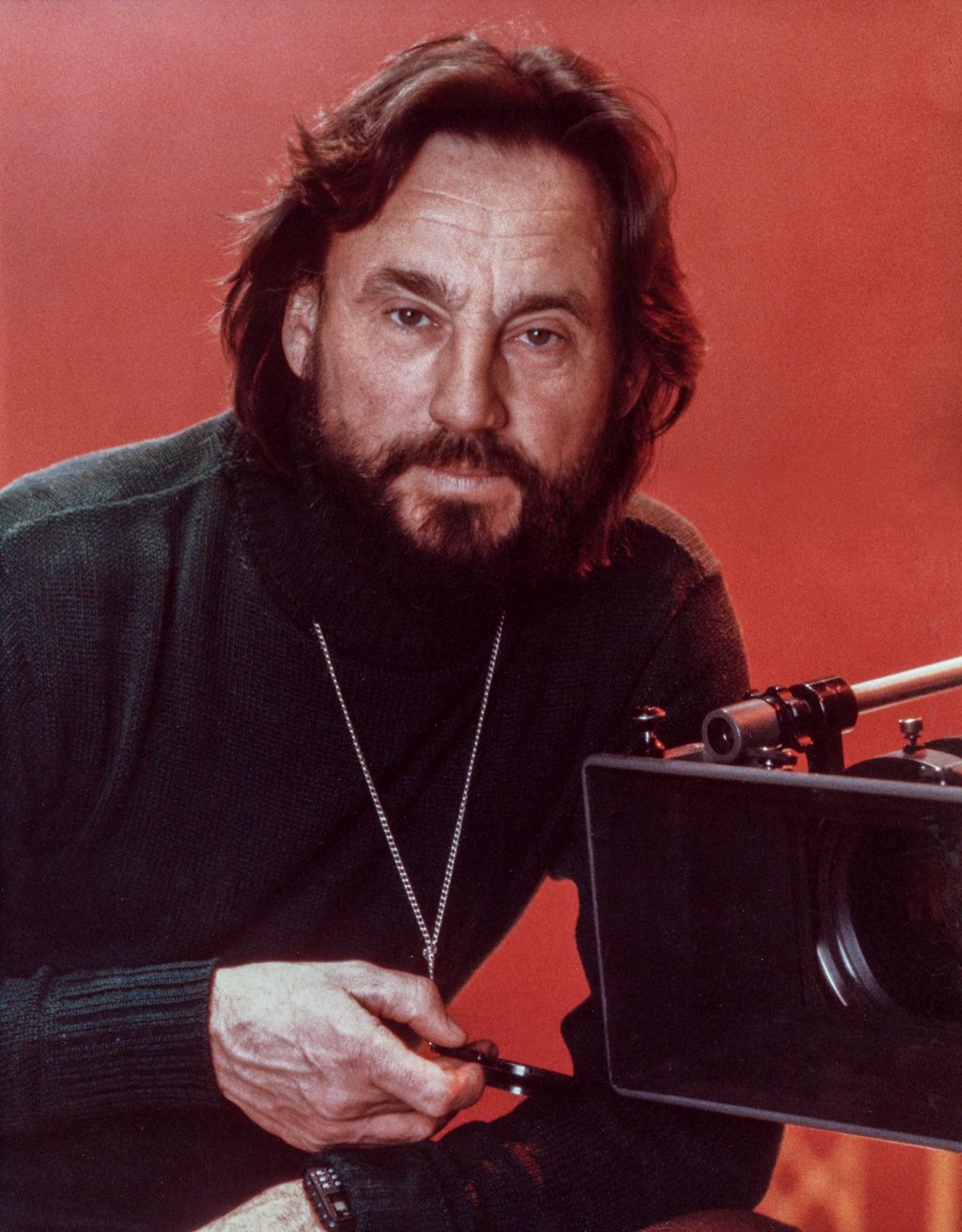
There is a tiny bit I can add to the recent eulogies for the great Vilmos Zsigmond, legendary cinematographer who escaped to the West from his native, communist-controlled Hungary with friend László Kovács. Before their Hollywood careers took off, the pair toiled in low-budget films, and even together as they did on Ray Dennis Steckler’s The Incredibly Strange Creatures Who Stopped Living and Became Mixed-Up Zombies (1964). During this era, Zsigmond had the distinction of shooting Arch Hall and James Landis’ The Sadist (1963), one of the most effective no-budget movies made by anyone, anywhere and the one movie that wipes out the perception that Hall and his son Arch Hall Jr. were not that talented. (Junior’s Beavis hairstyle, pretty ridiculous in Wild Guitar and Eegah, even makes sense in this movie.)
Zsigmond was still picking up some lower budget jobs by the mid-70s when he worked on the Phil Tucker production Death Riders (1976), a documentary about stunt motorcyclists produced under the working title Star Spangled Bummer. In 2007, I found an address for Mr. Zsigmond and mailed him a letter, hoping that he might have something to say on the topic of Phil Tucker and this film. To my delight, he replied with a note written on my letter, giving me his home phone number and the word “Unlisted!” added in, giving me a fun moment of being let in on something. So I called him a couple of times and got an answering machine, to which I left a message at least once.
Eventually, my phone rang one evening and I was in amazement to see his name on my caller ID. From there, it was a pleasant little chat of about five minutes in which he remembered the Death Riders production, and related that he was greatly impressed by Phil Tucker’s generosity and overall easygoing personality. (I got the sense it went less well with the film’s director Jim Wilson.) Tucker had even, as he remembered, bothered to call him up and let him know how it all went, as Zsigmond worked on it for a couple weeks and departed. He was a little blindsided when I let him know that Tucker had passed on, which he had not known. The conversation ending cordially, I got the sense he was in the midst of getting to somewhere, sounds of outdoors being audible throughout the call. (Or maybe he was just out for an evening stroll, and I shouldn’t assume that the life of a DP is non-stop itinerancy.)
So as I can attest by his kind attention to someone he didn’t know from anyone, Mr. Zsigmond was a classy guy through and through. But this is obvious from his life: risking capture with smuggled film while escaping communist Hungary, and then a career of always being a consummate professional on the job, eventually making it to the highest pinnacle of his profession. Rest in peace.

George Barrows.
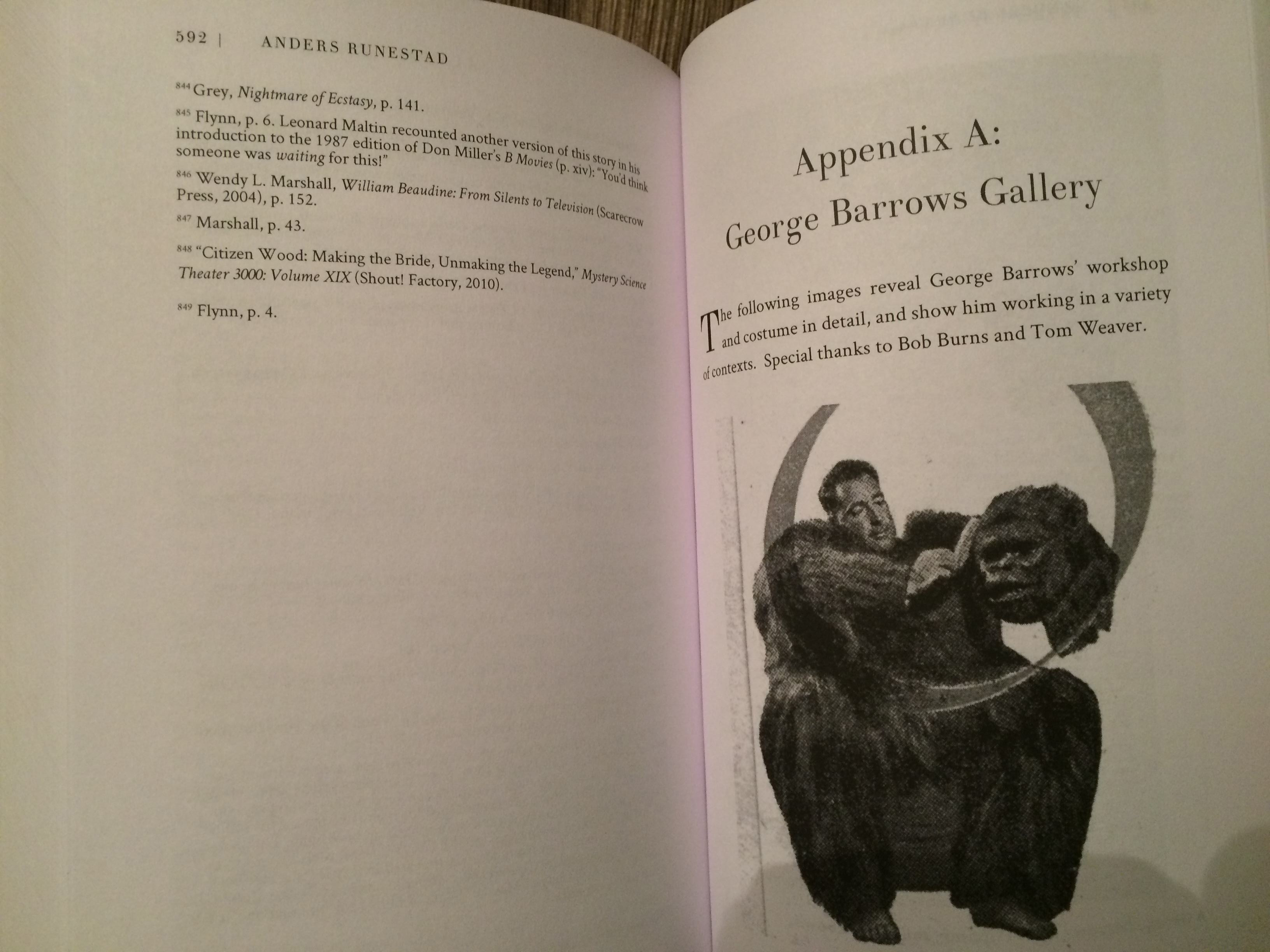
A Barrows gallery.

Barrows’ workshop.
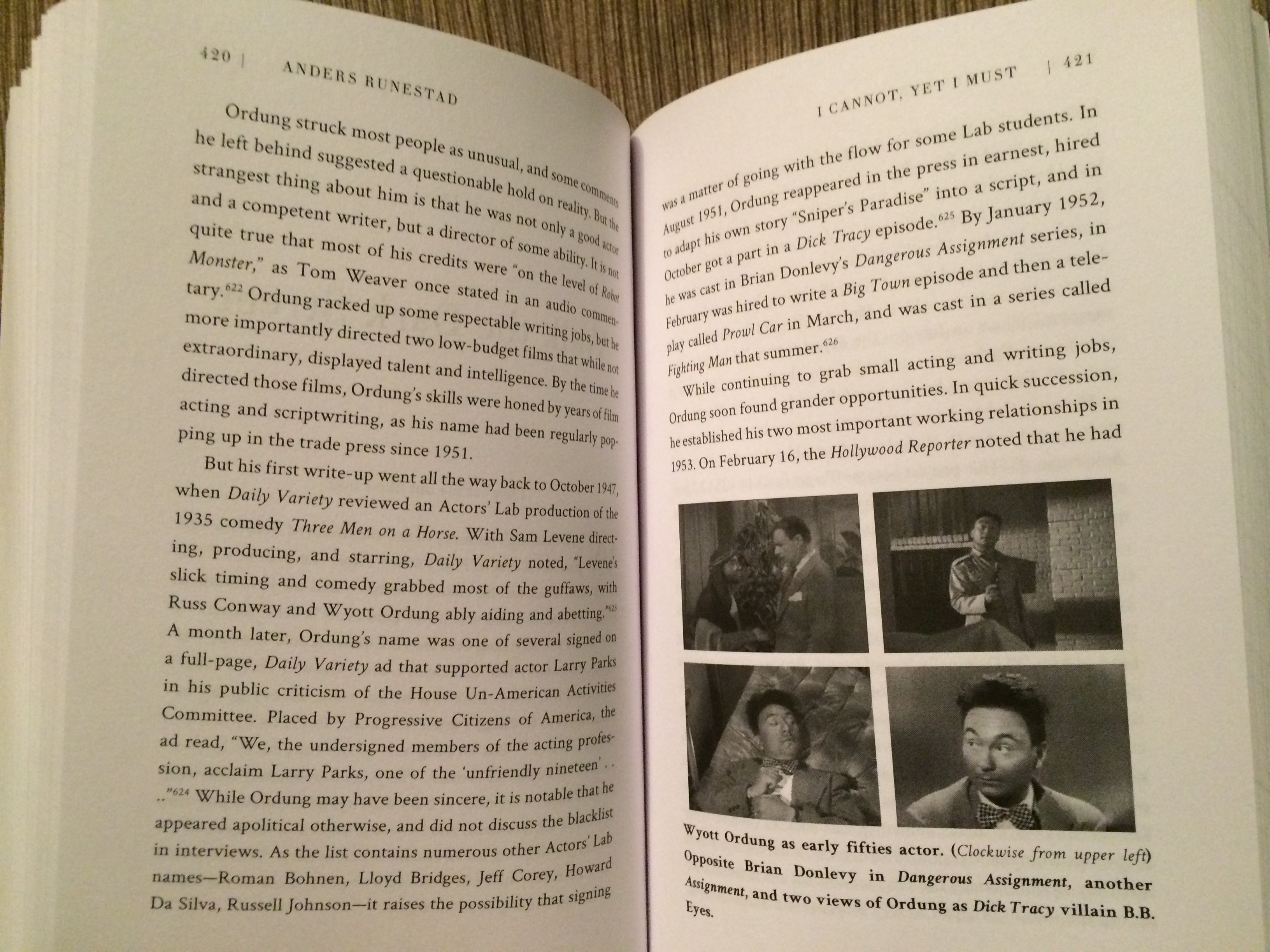
Wyott Ordung as actor.
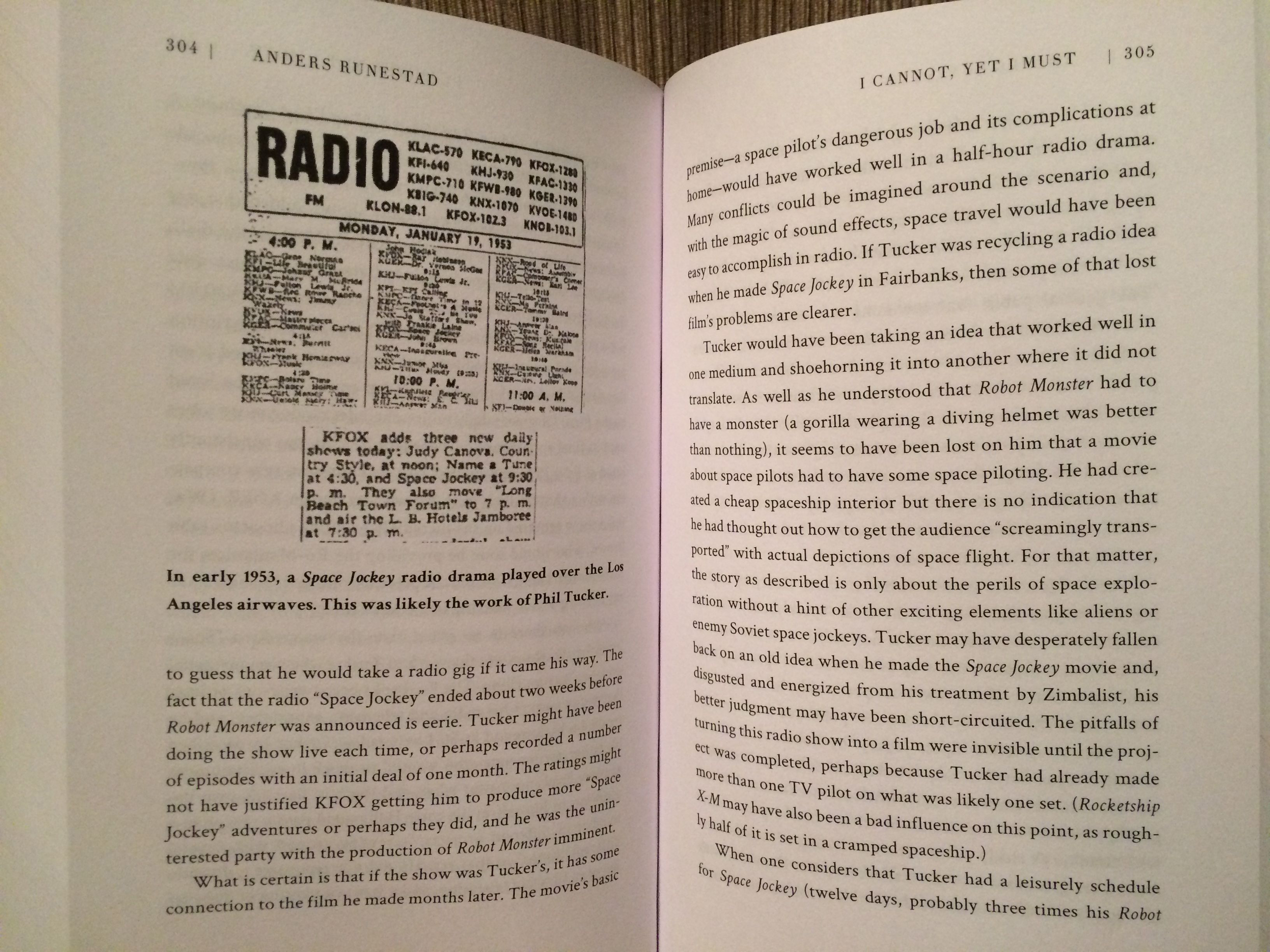
Space Jockey, the radio drama.

Robot Monster script.
Available in print from Amazon.
I’ll have more to say about it soon, but more for the moment just wanted to share some photos:

This is the front cover, glossy.

696 pages. This gives you an idea of the dimensions (8.5 x 5.5 trim size). No quality comparisons implied.
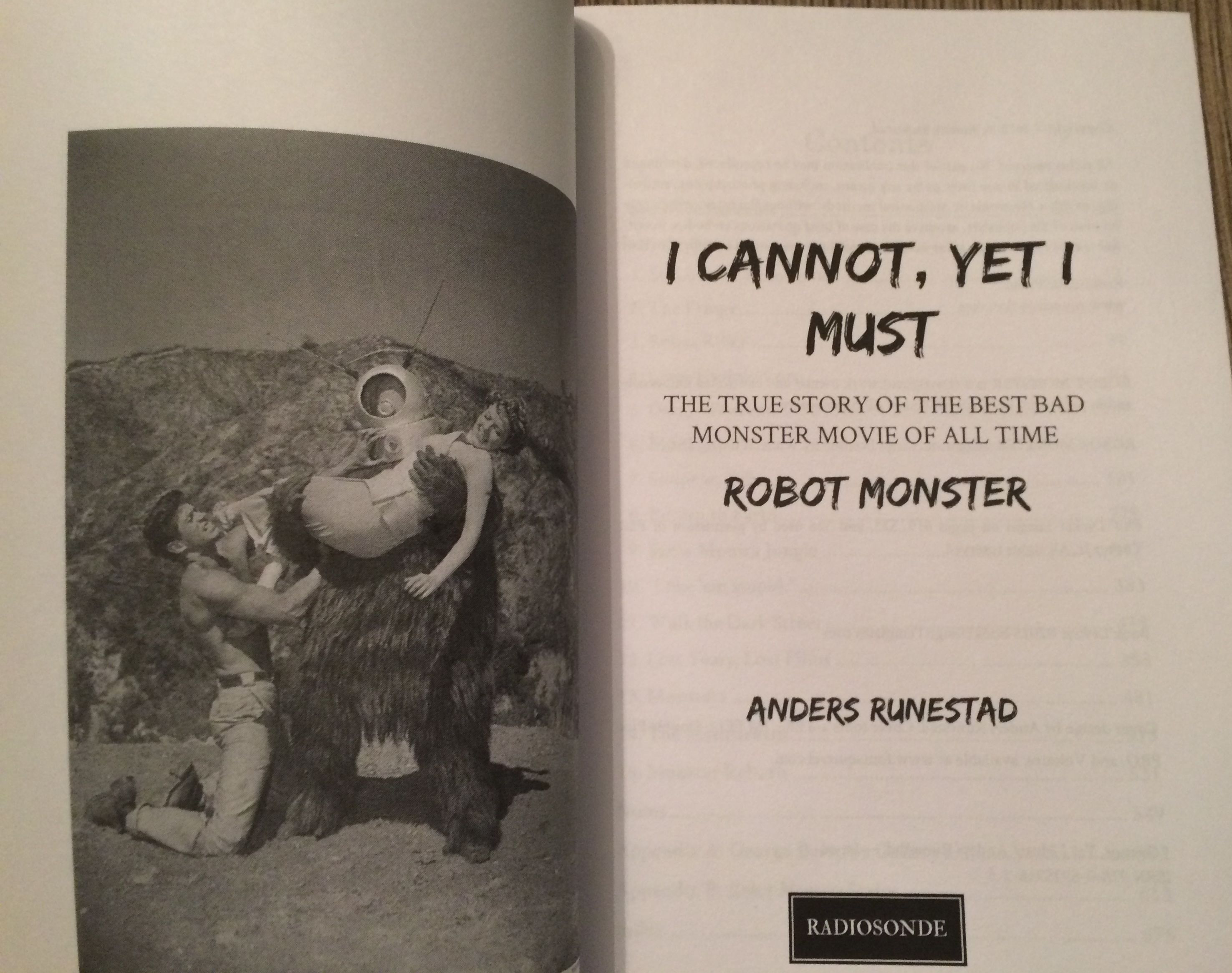
Title page.

And a couple pages for now. More to come!
For anyone who’s been checking this blog, my apologies for not keeping it up to date. I’ve been working on book formatting, and getting all things of a book nature wrapped up. Big announcement coming soon . . .
So after Dream Follies, what came next?
Probably Pachuco. . . . Pachuco was the first real picture I ever made. And when I say that, I mean in the sense that it was a real picture made in a real way for real markets, that told a story I wanted to tell. The usual shortage of money just didn’t affect me this time. We would sleep in the studio at night, the same studio that I did Dream Follies and Dance Hall Racket. We would sneak in there at night and work from around 10:00 at night ’til about 4:30, 5:00 o’clock in the morning. If all the time had been like ten-hour days, we probably spent ten, twelve days on the picture, which was remarkable for me at that time. It was a very violent picture, it was a very realistic and true picture, and it told a little story.
However good Pachuco really was, it was not by-the-numbers burlesque junk, and Tucker remembered it with pride. As his repetition of the word “real” emphasizes, this movie was notches above his others, “a story [he] wanted to tell.” Tucker was not financially strained either because of backing or, far more likely, because he was pulling the movie off on next to nothing. The paradox of how he made his best movie on no resources is unraveled by the fact that he worked late at night when no one was around. The location was Quality Studios and Tucker’s familiarity with Connell and his back-alley soundstage may have literally given him the keys to using it in the off hours, with or without Connell’s knowledge. Whatever the movie was like, it was violent and Tucker therefore believed it had box office potential.
I subsequently got the picture in halfway decent shape; I edited myself. I took it to distributors, and some liked it, some didn’t like it; nobody would really [release it]. Then a guy named Bill Hackel, who has since died, saw it. Bill produced most of Republic’s cheap pictures. He was executive producer of all their “Bs.” Bill loved it. He thought it would really do well.
The Bill Hackel that Tucker refers to was A.W. Hackel, who formed the independent company Supreme Pictures in 1934. Born in Austria in 1882, he was (according to Guy Woodward Finney’s 1929 book The Great Los Angeles Bubble) one of many (including Louis B. Mayer) involved in the Julian Petroleum oil stock scam that collapsed in 1927. Hackel was also there when Poverty Row kingpin Republic Pictures formed out of the 1935 union of Consolidated Film Laboratories and other small companies, including his own. His Supreme Pictures remained separate from the Republic conglomeration, but they acted as distributor to many of the action-filled B Westerns he ground out with his stars, Bob Steele and Johnny Mack Brown. William C. Thompson shot a couple of Hackel’s horse operas, 32 of which featured the steely-eyed Steele, and 16 with the athletic Brown. (Brown, first a football star, was an MGM lead in Hollywood, and starred in King Vidor’s Billy the Kid (1930), shot by Tucker’s mentor, Gordon Avil.)
According to Don Miller, “. . . the budgets were lower than before [in Steele’s career], and the pictures were ground out two or three at a time . . .. they were conventional Westerns, made for and played in lesser theaters.” Miller allows that Hackel’s quality may have increased after he “signed a deal with Republic for the 1936-37 season,” but still writes that Hackel’s Steele Westerns “suffered in comparison” to Republic’s own material. Republic dropped Hackel “at the end of the 1937-38 season,” but he continued producing into the 1940s. Am I Guilty? (1940) was a state’s-rights production aimed at black audiences, while most of his subsequent work as producer was done at Monogram. At least four of those productions, mostly crime thrillers, were directed by William “One Shot” Beaudine. Hackel’s last credit is for co-producing the Nazi invasion melodrama Strange Holiday (1945) with Claude Rains, which was one of Arch Oboler’s first movies as a director. Hackel then appears retired from film production until his death in October 1959, and he may have never been very hands-on. According to Sam Sherman:
Of the line producers who actually made films, many only received credit as production manager or supervisor, while many received no credit, so the production company head could claim the producer’s credit for himself. The real producer of the 1935-36 Bob Steele series for A.W. “Bill” Hackel’s Supreme Pictures was actually Sam Katzman, although you would never know it from the screen credits.
Katzman would go on to become one of Hollywood’s most prolific and profitable low-budget producers on his own, so this uncredited early work was, in the long term, good training.
Tucker’s wording is ambiguous about when he met Hackel, but they could have easily known each other for years. Hackel’s Bob Steele Westerns were at first directed by Steele’s father, Robert N. Bradbury, but then by Sam Newfield. His brother with an un-Americanized name, Sigmund Neufeld, would found PRC and keep Sam busy directing; Robot Monster’s director of photography, Jack Greenhalgh, was a PRC regular.
So [Hackel] put up the money for me to make a trip to Texas—Amarillo—and do a test there. We had a three-day weekend; a Friday, a Saturday, and a Sunday. We had two days of promotion. In those days, you still couldn’t use television; we used radio, we used newspapers. I think we spent about five or six hundred bucks for those two days, and a trailer that had been at the drive-in.
Tucker knew the state’s-rights distribution system well and, from his years of making cheap Westerns, Hackel was just as familiar. Why Amarillo was specifically chosen is unknown, but at the same time not a mystery. A Texas audience’s reaction would be more representative of the film’s long-term reception than a viewing closer to Hollywood and, as established in Chapter 9, Tucker’s earlier films had played in Texas. They even seem to have kept on playing the Lone Star State up to that point, to judge by a March 1960 Llano News ad for Bagdad After Midnight. Fifties Amarillo also had many theaters, including at least four drive-ins and some that catered to Spanish-speaking audiences. The city had also been used to premiere actor Robert Clarke’s own attempt at low-budget filmmaking, The Hideous Sun Demon, in August 1958. Clarke had no local prospects for his film but found that he could premiere it at an Amarillo drive-in, thanks to help from his brother who worked in sales at a local TV station. (Theater owner Blue Doyle had at least three Amarillo drive-ins.) Clarke prepared his own advertising materials, flew in with co-star Nan Peterson, and did a radio interview to promote the movie. Depending on when Pachuco was made, Clarke’s use of Amarillo could have been an influence.
Copyright 2015, Anders Runestad
 RUNESTAD WRITES