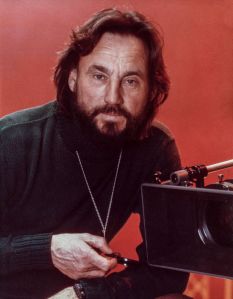
There is a tiny bit I can add to the recent eulogies for the great Vilmos Zsigmond, legendary cinematographer who escaped to the West from his native, communist-controlled Hungary with friend László Kovács. Before their Hollywood careers took off, the pair toiled in low-budget films, and even together as they did on Ray Dennis Steckler’s The Incredibly Strange Creatures Who Stopped Living and Became Mixed-Up Zombies (1964). During this era, Zsigmond had the distinction of shooting Arch Hall and James Landis’ The Sadist (1963), one of the most effective no-budget movies made by anyone, anywhere and the one movie that wipes out the perception that Hall and his son Arch Hall Jr. were not that talented. (Junior’s Beavis hairstyle, pretty ridiculous in Wild Guitar and Eegah, even makes sense in this movie.)
Zsigmond was still picking up some lower budget jobs by the mid-70s when he worked on the Phil Tucker production Death Riders (1976), a documentary about stunt motorcyclists produced under the working title Star Spangled Bummer. In 2007, I found an address for Mr. Zsigmond and mailed him a letter, hoping that he might have something to say on the topic of Phil Tucker and this film. To my delight, he replied with a note written on my letter, giving me his home phone number and the word “Unlisted!” added in, giving me a fun moment of being let in on something. So I called him a couple of times and got an answering machine, to which I left a message at least once.
Eventually, my phone rang one evening and I was in amazement to see his name on my caller ID. From there, it was a pleasant little chat of about five minutes in which he remembered the Death Riders production, and related that he was greatly impressed by Phil Tucker’s generosity and overall easygoing personality. (I got the sense it went less well with the film’s director Jim Wilson.) Tucker had even, as he remembered, bothered to call him up and let him know how it all went, as Zsigmond worked on it for a couple weeks and departed. He was a little blindsided when I let him know that Tucker had passed on, which he had not known. The conversation ending cordially, I got the sense he was in the midst of getting to somewhere, sounds of outdoors being audible throughout the call. (Or maybe he was just out for an evening stroll, and I shouldn’t assume that the life of a DP is non-stop itinerancy.)
So as I can attest by his kind attention to someone he didn’t know from anyone, Mr. Zsigmond was a classy guy through and through. But this is obvious from his life: risking capture with smuggled film while escaping communist Hungary, and then a career of always being a consummate professional on the job, eventually making it to the highest pinnacle of his profession. Rest in peace.
 RUNESTAD WRITES